


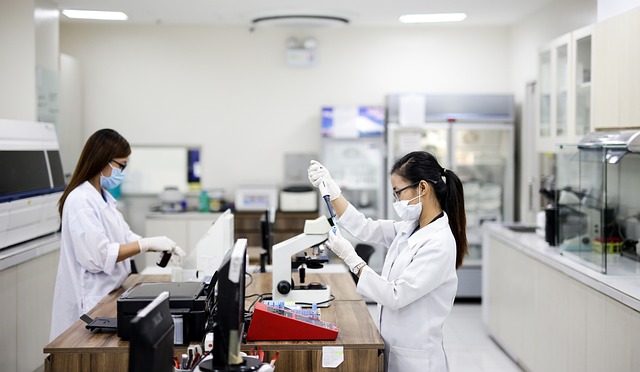
Medical Biotechnology
If you are a graduate of a first-cycle (Bachelor’s) degree program in the field of exact and natural sciences, medical and health sciences, agricultural sciences, or related disciplines, and you are interested in biotechnology—especially in the application of its achievements in medicine—join us!
Medical Biotechnology is an interdisciplinary program with a general academic profile that combines biotechnology and medicine. You will learn, among other things, how drugs are designed and produced using biotechnological methods, gain comprehensive knowledge of conducting preclinical studies, and acquire the skills and qualifications required to carry out research on laboratory animals.
The program prepares graduates for careers in the medical, pharmaceutical, and research and development sectors.
At the very beginning of your studies, you will choose a diploma seminar that will enable you to conduct laboratory research in a field of interest under the supervision of experienced scientists. Study Medical Biotechnology at KUL, as we place strong emphasis on practical classes and the development of hands-on laboratory skills. Classes are conducted in small groups of eight students, which allows for active participation and easy access to modern laboratory equipment.
Information
- Second degree studies (2 years)
- full-time studies
- degree obtained: Master
- language of study: english
- planed number of places: 20
- Faculty of Medicine
- STUDY PROGRAMME
- Tuition fee: 15150 PLN / semester
Educational requirements
Diploma requirements
BA diploma in a following field of study is required:
biotechnology, biology, biomedicine, microbiology, environmental engineering, environmental protection, or related field of study.
The above-mentioned fields must fall within one of the following disciplines:
- exact and natural sciences;
- engineering and technical sciences;
- medical and health sciences;
- agricultural sciences.
*In specific cases, after comparing the learning outcomes achieved during the bachelor’s program, candidates may be advised to take additional courses.
Legalization/recognition of educational documents issued abroad
Required documents
In addition to a Bachelor Diploma a candidate is also required to submit:
* the written part of Polish matura examination in English language at the advanced level with the result 60% or higher is tantamount to a certificate confirming English language proficiency at level B2.
Score convertion rules
Admissions Office KUL will convert your results into Polish grading system according to the score convertion rules
Why Medical Biotechnology at KUL?
Why choose this programme?
- The Biotechnology programme is ranked 10th in Poland and 1st in Lublin according to the PERSPEKTYWY ranking.
- Classes are conducted in modern laboratories equipped with advanced research apparatus.
- Laboratory classes are held in small 8-person groups, ensuring active student participation.
- Students of all years can participate in free certified training courses funded by the Ministry of Science and Higher Education (MNiSW) and the National Centre for Research and Development (NCBR).
- Medical Biotechnology students may participate as researchers in projects funded by the National Science Centre (NCN), MNiSW and NCBR.
- Classes are taught by research and teaching staff with extensive experience in scientific projects.
The programme is conducted within two scientific disciplines evaluated by MNiSW: Biological Sciences (category B+) and Medical Biology.
What will you learn? Scope of studies
Example courses include:
- Molecular Modelling
- Green Chemistry
- Cancer Pathogenesis and Current Therapeutic Strategies
- Molecular Basis of Drug Action
- Microbiome in Health and Disease
- Fundamentals of Designing Preclinical and Clinical Research
- Work with Laboratory Animals
- Genomics and Proteomics
Most courses are delivered as lectures combined with practical laboratory classes and include content related to the use of artificial intelligence.
Practical elements:
- Specialist English for biotechnologists, enabling students to master professional terminology.
- Additional workshops and training focused on specific research methods (e.g. chromatography, flow cytometry).
Hands-on experience with advanced research equipment during master’s thesis research.
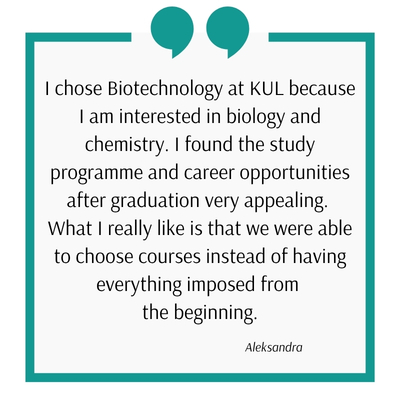
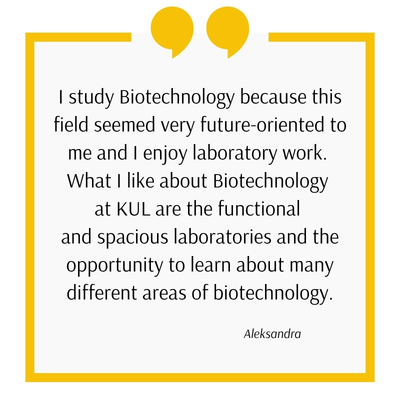

Studies prepare for:
Graduate qualifications and career prospects
Formal qualifications:
- Certificate confirming completion of training in the handling of laboratory animals for persons participating in procedures, in accordance with Polish legal regulations.
Job positions:
- Junior Laboratory Specialist (Molecular Biology)
- R&D Specialist – Drug Biotechnology
- Laboratory Technician in a Molecular Laboratory
- Quality Control / Quality Assurance Specialist (QA/QC)
- Research Assistant / Research Associate
- Bioinformatician
- Preclinical Research Analyst
- Biological Methods Validation Specialist
Graduate competencies:
- Knowledge of quality management systems and intellectual property protection procedures.
- Ability to operate modern and specialised research equipment (e.g. chromatography, electrophoresis, spectrophotometry, microscopy).
- Ability to write scientific papers and present research results in English.
- Ability to plan experiments and analyse results.
- Ability to cooperate with specialists from other fields, particularly at the interface of biotechnology and medicine.
Further education opportunities:
– Postgraduate studies
– Doctoral studies at Doctoral School
Our Graduates:
Our graduates work in:
- Universities and research institutes (e.g. the Polish Academy of Sciences).
- Research, control and diagnostic laboratories and pharmaceutical companies.
- Companies offering specialised research equipment and laboratory materials.