


MA Philosophy
What can I know? What should I do? What may I hope for? If these and similar questions arouse your curiosity and you want to embark on an intellectual journey in search of answers, studying Philosophy will enable you to both familiarize yourself with the legacy of the “giants” of classical philosophy and take part in current debates concerning the most significant problems facing modern humans. Among numerous currents and styles of philosophizing, we propose a unique way of practicing philosophy characteristic of the Lublin School of Philosophy. We introduce you to the meanders of searching for the truth about the world, God, and human beings (metaphysics and philosophical anthropology), sensitize you to values (ethics – especially personalistic, co-created by a professor of our Faculty – Karol Wojtyła), familiarize you with basic concepts and problems that have occupied human minds for centuries (history of philosophy), and teach the art of precise thinking, speaking, and effective argumentation (logic and methodology).
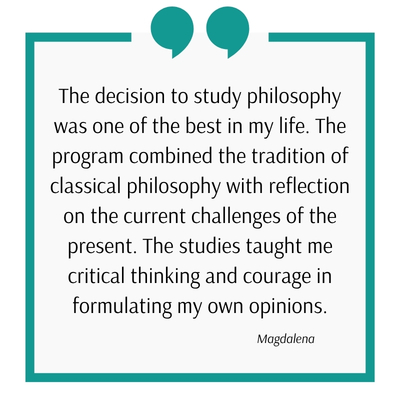
Philosophical studies respond to the challenges of the modern world – the need for critical thinking, resistance to manipulation, and the ability to understand complex social and cultural phenomena. This is a proposal for those who want to seek the truth and shape a mature and responsible outlook on reality.
Information
- Second degree studies (2 years)
- full-time studies (hybrid)
- degree obtained: master
- language of study: english
- planed number of places: 20
- Faculty of Philosophy
- STUDY PROGRAMME
- Tuition fee: 5400 PLN /semester
Educational requirements
Diploma requirements
Higher education diploma (when you apply to a MA programme you need to upload a copy of your BA/MA diploma – a document which allows you to continue studies at MA degree in your country).
Legalization/recognition of educational documents issued abroad
Required documents
In addition to a BA/MA diploma a candidate is also required to submit:
* the written part of Polish matura examination in English language at the advanced level with the result 60% or higher is tantamount to a certificate confirming English language proficiency at level B2
Score convertion rules
Admissions Office KUL will convert your results into Polish grading system according to the score convertion rules
Why Philosophy at KUL?
Why is it worth choosing this field of study?
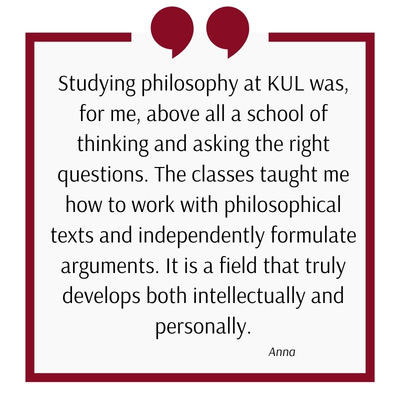
- Deepening of knowledge and research skills – the study program develops independent thinking, analysis of source texts, and the preparation of a Master’s thesis within scientific seminars under the supervision of a lecturer.
- Translation classes and access to sources in the original – classes in Latin and a modern language allow for the study of classical and contemporary philosophical texts in the original.
- Scientific seminars – enable the development of personal philosophical interests and the acquisition of practical research skills, such as source text analysis, formulating arguments, or preparing a bibliography.
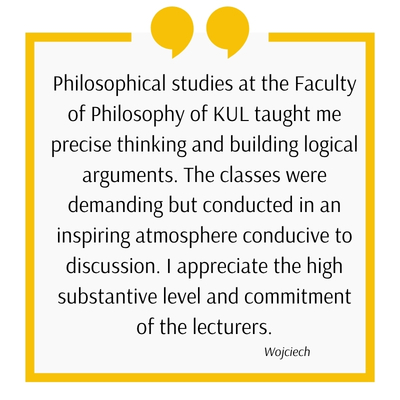
- High quality of education and prestige – philosophy at KUL is highly rated by the Polish Accreditation Committee (category A) and holds high positions in the “Perspektywy” Ranking, which confirms the reputation of the field.
- Flexible mode of studying – most classes are held using distance learning methods and techniques with three stationary sessions per semester, allowing for the combination of studies with professional work while maintaining high educational standards.
What will you learn? Scope of studies
Master’s studies allow for the deepening of philosophical knowledge and the development of research skills. The program covers key subdisciplines: logic, epistemology, metaphysics, ethics and bioethics, history of philosophy, philosophy of science as well as philosophical anthropology and philosophy of culture.
Students participate in elective tutorials, developing their own interests and analytical skills, e.g.:
- The drama of human freedom and its anthropological foundations in ancient and medieval history
- Evolutions of art and aesthetics – philosophical histories;
- Philosophical problems of research on responsible Artificial Intelligence;
- Bioethical disputes over interference in human nature;
- Religion and spirituality from the perspective of philosophy;
- Philosophical aspects of education;
- Philosophical sources of contemporary psychotherapy.
The program emphasizes the practical use of a modern language (B2+ level), enabling the reading of philosophical texts in the original as well as conducting scientific discussions and presentations.
Studies prepare for:
What will graduates be entitled to after graduation
The obtained Master’s degree in philosophy allows for the continuation of education in doctoral studies (PhD) or postgraduate studies, deepening research competences and opening the way to a scientific career or interdisciplinary research activity.
The graduate possesses in-depth research and analytical skills. They can formulate and analyze philosophical problems, select appropriate research methods and tools, and present the results of their research in a clear and logical manner. They are able to discuss, summarize, and paraphrase both their own and others’ views as well as critically evaluate various philosophical positions.
Thanks to developed language competences (modern language at B2+ level), the graduate can independently translate, interpret, and analyze texts in a foreign language, and uses the acquired research skills in teamwork and in conducting independent scientific projects. They are prepared for active participation in activities for the preservation of philosophical and cultural heritage.
Our Graduates:
Our graduates work at:
Our graduates work in publishing houses, editorial offices, cultural institutions, media, local government, the advertising industry, IT, business, and even politics. Many of them continue their scientific careers at universities or teach ethics and philosophy in schools. Philosophical studies at our Faculty shape the mind so that the graduate can find their place in any industry, especially where logical thinking, creativity, solving difficult problems, analyzing complex issues, and rapid acquisition of new skills are valued.
Where can students complete their internships
No internships in the second-cycle (Master’s) of philosophy.
Student Life and academic community
Student life in the Philosophy second-cycle field is active and inspiring. Students can be active in the Faculty Student Council and the KUL Students’ Philosophical Society, which integrates the philosophical community and develops competences useful in the labor market. As part of the Society, participants take part in training, conferences, scientific trips, discussion meetings as well as publishing and scientific work.
Every year, students organize the Philosophical Week and actively participate in the Open Day of the Faculty of Philosophy, presenting the field to future candidates and showing the creativity and commitment of the philosophical community.
Second-cycle students also have the opportunity to complete part of their studies within the Erasmus+, MOST, or other forms of international exchange. In recent years, they have traveled, among others, to the Catholic University of Leuven (KU Leuven) in Belgium, gaining academic and cultural experience at a prestigious foreign university.