


Applied Anthropology
Anthropology is the study of man. Explore, Understand, Impact.
Who are you? What is your role in society and your place in the universe?
At Applied Anthropology, you will gain knowledge about yourself and develop essential life skills.
This program integrates the major anthropological disciplines – physical anthropology, linguistics, archaeology, and socio-cultural anthropology – while uniquely incorporating philosophical anthropology.
Enhance your self-awareness through hands-on experience!
Internships and placements at global and Polish pro-social, economic, and charitable institutions will prepare you for real-world, often surprising challenges and equip you with the skills to make a meaningful difference in your life and the world.
Information
- First degree studies (3 years)
- full-time studies
- degree obtained: bachelor
- language of study: english
- planed number of places: 20
- Faculty of Philosophy
- STUDY PROGRAMME
- Tuition fee: 5100PLN/semester
Educational requirements
Foreign Secondary School Certificate / IB / EB diploma / Polish "matura" certificate
Competition on the basis of secondary school certificate – the result of the written test is scored on the following subjects:
a) Polish language or native language(50% of the final result) and
b) one of the following subects: mathematics, foreign language, history, biology, chemistry, physics, informatics, civic education, geography, Latin and ancient culture, history of art, history of music or philosophy (50% of the final result). If an applicant passed more than one of the above subjects, the best result is taken into consideration.
Legalization/recognition of educational documents issued abroad
Required documents
In addition to a Secondary School Certificate a candidate is also required to submit:
* the written part of Polish matura examination in English language at the advanced level with the result 60% or higher is tantamount to a certificate confirming English language proficiency at level B2
- a certificate/statement confirming prosocial engagement with a description of the activities you participated in. Document confirming candidate’s prosocial engagement:
– it could be a confirmation/diploma/certificate from any social/voluntary institution where an applicant worked as a volunteer;
– it could be a statement confirming and describing examples of voluntary/prosocial activities. Statement written by applicant must be hand-signed.
Score convertion rules
Admissions Office KUL will convert your results into Polish grading system according to the score convertion rules
Entrance examination - requirements
For candidates with a certificate/diploma obtained in a country other than a member state of the EU, OECD, EFTA, Ukraine or China, the entrance examination is required.
Exam topics:
Candidates’ knowledge, competencies, and skills are verified by analyzing a specialized text and summarizing the following topics:
- Why did you choose to study anthropology and philosophy in Poland, specifically at the Catholic University of Lublin?
- Which issues or topics in your chosen field of study interest you the most?
- How has your education prepared you for your chosen field of study?
- How do you envisage your professional future after completing your studies?
- Are there any facts, historical events or works of art related to Poland that you know about? What impression did they make on you?
- What are your plans for learning and improving your knowledge of the Polish language?
- What challenges do you foresee when studying in Poland as a foreigner, and how do you plan to overcome them?
- Have you participated in social activities, volunteering or cultural projects? Tell me about your experience.
- What opportunities and threats do you see in multicultural environments?
- What values or ideas are important to you within your cultural context?
Why Applied Anthropology at KUL?
Why should you choose this programme?
A graduate of Anthropology completes one of the most recognizable university programs in the world. However, the Applied Anthropology program at the John Paul II Catholic University of Lublin is unique in Poland, as it integrates major subdisciplines of anthropology. It is also distinctive internationally, combining mainstream and philosophical anthropology. The program offers comprehensive academic knowledge alongside in-depth philosophical analyzes, questions, and hypotheses focused on humanity.
The Applied Anthropology program features highly interdisciplinary courses delivered through diverse teaching methods, including blended learning and training in learning agility. Classes are led by specialists from various scientific disciplines, ranging from international economics, tribal languages, archaeology, human evolution, art, management, and intercultural communication, to Greek, Polish, and Arabic languages and cultures, as well as two Western languages. The curriculum also includes courses in humanitarian and immigration law and aid, working with the marginalized groups, foreign language teaching, and the ethics, ontology and history of philosophical anthropology. This holistic approach to humanity provides a strong foundation for understanding the meaning of human existence.
In the field of internships, experts (IBE, BCU) predict the growing importance of advanced interpersonal skills (including motivating employees, resolving conflicts, and managing stress in high-pressure situations). Multidisciplinary skills, such as data analysis, experience design, and optimization, are also increasingly important. Accordinly, and unusually in Poland, the Applied Anthropology program at KUL offers not only mandatory internships but also optional semester-longinternships in Poland and abroad, including Erasmus+ and humanitarian missions. These experiences will equip you with unique competencies that will help you meet life’s unexpected challenges.
You can complete internships, among others, in organizations and institutions whose staff also serve as your lecturers during the program, including ICRC, PCK, Caritas, VIDES, Volunteer Center, and the Global Solidarity Association.
What will you learn? Scope of studies
During your studies, you will explore and understand key aspects of knowledge about humanity, ranging from biological and linguistic, to social, artistic, and metaphysical dimensions.
You will learn to ask meaningful questions and seek well-founded answers, select appropriate methods – especially fieldwork and qualitative approaches – and make informed decisions, organize information and critically evaluate sources.
You will study at least three foreing languages (excluding English) and gain knowledge of different cultural regions of the world.
The program equips you with the ability to analyze anthropological texts, collect and interpret ethnographic, sociological, and economic data, assess socio-cultural and philosophical issues, and anticipate the implications of social actions. You will acquire entrepreneurial competencies, identify market opportunities, generate social value, secure project funding, and effectively manage initiatives.
You will also become proficient in ICT tools and develop analytical skills to evaluate and interpret anthropological issues in social, humanitarian, economic, legal, political, and educational contexts.
In addition, you will learn to act creatively and responsibly in a social, intercultural, and economic environments.
In addition to mandatory and optional internships, you will participate in practical classes and workshops, such as exercises and case studies in critical thinking, work with the marginalized children and youth, ethics, ethnography, intercultural communication, international business, security and safe life projects, cultural and intercultural community inclusion, interreligious dialogue, health care mediation, media discourse analysis, ESL teaching, legal documentation and immigration procedures, and business and charitable practices.
You will develop your bachelor’s thesis in seminars devoted to philosophical and intercultural studies of humanity and/or a seminar dedicated to economics as a fundamental area of human survival and fulfillment in the world.
A Practical & Interdisciplinary Approach
Applied Anthropology is a dynamic and interdisciplinary program, with a general university profile. It addresses complex social problems and fosters pro-social, intercultural, business, communication, and educational competencies.
The program responds to the growing demand for graduates with strong intercultural and social competences, especially the soft skills valued by employers, as well as knowledge of languages and cultures, business competencies, and digital skills.
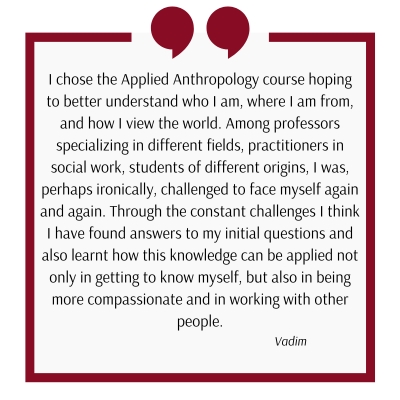
You will develop analytical and critical thinking skills, linguistic and digital proficiency, and adaptability while cultivating openness, empathy, creativity, and flexibility in understanding social phenomena and enhancing the well-being of individuals and groups.
Studies prepare for:
What will graduates be entitled to after completing their studies?
- Graduates of the Anthropology program complete one of the most internationally recognized university degree programs. They are among the most sought-after professionals on the global job market thanks to their unique qualitative research competences, including ethnographic “thick description,” which enables them to understand the diverse and contextual determinants of human choices and actions. In addition, they develop strong analytical, critical, causal, synthetic, and socio-cultural skills.
- In this respect, graduates of the Applied Anthropology program at KUL are well prepared to succeed in job markets worldwide, particularly in fields such as User Experience research, which requires competences in Design Thinking, market and social research, workplace diversity management, and Service Design. After obtaining additional professional certifications (e.g. from PTBRiO, Symetria/UX-PM, IxDF, or Nielsen Norman Group), graduates may pursue careers as socio-economic research specialists, marketing and sales specialists, market trend analysts (cool hunters), UN or EU project coordinators.
- Anthropology is fundamentally a discipline that responds to global challenges related to migration, globalization, and social exclusion. For this reason, a degree in Applied Anthropology at KUL certifies qualifications for employment as an intercultural integration specialist (applying knowledge of cultural differences in the NGO and public sectors), intercultural assistant, social communication specialist, or public relations professional who understands cultural codes as key elements of effective brand communication.
Thanks to their in-depth knowledge of human behavior and their ability to analyse the causes of decisions and actions, KUL anthropology graduates acquire a broad and versatile set of professional competences. After meeting relevant professional requirements, they may work as HR consultants, personal assistants, personal coaches, education brokers, employment intermediaries, medical services brokers, or – owing to their multilingual skills – foreign language instructors. With their ethnographic training, they are also well prepared for careers in traditional or open-air museums, and cultural heritage protection institutions, serving indigenous, local, and national communities. - Moreover, graduates of the Applied Anthropology program at KUL are particularly well qualified to apply for positions in international humanitarian organisations, including the United Nations and its agencies (UNHCR, UNICEF), the ICRC, Caritas, ProCare, and others. These institutions offer opportunities to contribute to the well-being of individuals and communities at local and national levels. Additional training and certifications (such as Sphere Standards or PHAP: HNA and MEAL) complement the academic curriculum in this area.
- Finally, graduates may pursue academic, research, and expert careers in higher education and beyond. They may continue their studies at the Master’s level, specializing in selected subdisciplines of anthropology, such as biological, medical, socio-cultural, digital, linguistic, or religious anthropology. As anthropology programs are widely offered at leading universities worldwide, the choice of institution depends primarily on the candidate’s academic interests and personal circumstances.
- KUL anthropology graduates may also continue their education in philosophy (e.g. at the Faculty of Philosophy of KUL) or in related fields within the humanities and social sciences, including ethnography, cultural studies, international economics, and intercultural communication, at renowned institutions such as LSE, Brunel, Cambridge, Oxford, the Collège de France, as well as universities in the USA, South Africa, and Australia. Those pursuing a career in humanitarian assistance may complement their studies at universities within the NOHA network (e.g. University of Warsaw, University College Dublin), at the Institute of International Humanitarian Affairs (Fordham University), or through training at the Center for International Humanitarian Cooperation.
- Graduates may further enhance their professional profiles through specialized postgraduate programs and tailored professional training aligned with their chosen career paths.
Our Graduates:
Our graduates work at:
Graduates of Applied Anthropology at John Paul II Catholic University of Lublin have found employment immediately after graduation at international institutions such as Caritas Nigeria and ProCare Ireland, as well as in international marketing and consulting firms in IT and image management. Others work as language instructor at language schools or as intercultural assistants. Some graduates have also launched their own business ventures, for example as medical services brokers or international business intermediaries.
However, most graduates choose to continue their education by pursuing master’s degrees in anthropology, economics, humanitarian aid, IT, philosophy, management, or national security, as well as doctoral studies in philosophy.
Where can students complete their internships
Applied Anthropology students have the opportunity to independently choose the location of their mandatory and optional internships. A key criterion is the ability to achieve the learning outcomes of the anthropology program and workplace safety. Consent is provided by the internship supervisor at the Catholic University of Lublin. However, because contemporary anthropology is characterized by strong interdisciplinarity and interculturality, the range of institutions offering internships is broad and oriented toward effective pro-social action and the promotion of the well-being of indigenous, local, or national communities.
Students primarily complete internships in humanitarian organizations and service companies, where they undertake a wide range of activities related to institutional goals, including humanitarian, administrative, managerial, integration, educational, and marketing tasks.
Internships are available in institutions such as the International Association VIDES, particularly in humanitarian missions, e.g. in Zambia; organizations working with intercultural children and youth, Caritas Poland, Nigeria and Caritas Portugal, in the Volunteer Center, the Global Solidarity Association, and the international humanitarian aid group of the Polish Red Cross, or in the City Hall in the Department of International Affairs. Students may work as educational brokers, library assistants, promoters of intercultural inclusion, volunteers in language schools, or interns in service companies specializing in personalized customer service, service design, and market and contextual research.
Student Life and academic community
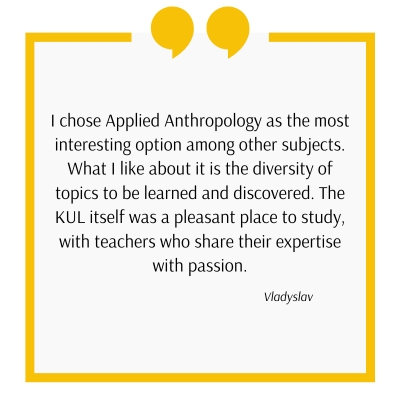
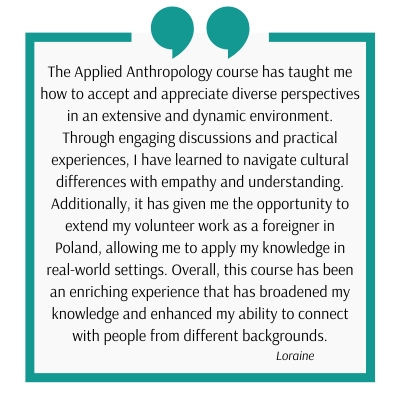
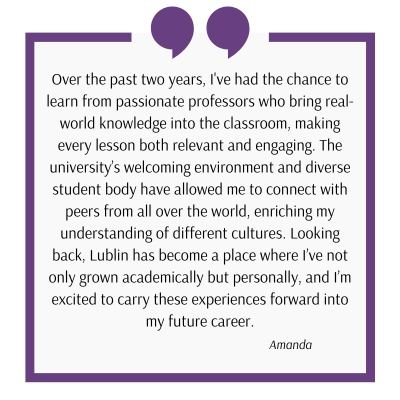
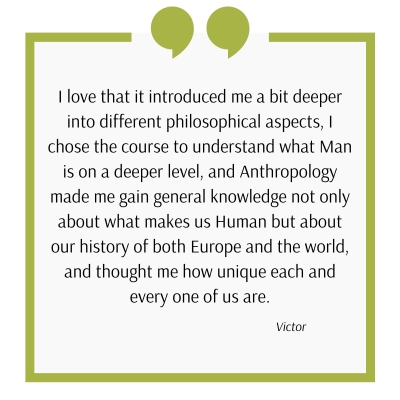
The student community in the Applied Anthropology program at the John Paul II Catholic University of Lublin (KUL) is highly intercultural. Students come from various countries and continents. They form a small, friendly group that supports one another in the learning process while maintaining friendly relationships with their teachers.
Furthermore, the Anthropology program provides a wide range of mandatory and elective courses in Polish language, culture, and academic culture, enabling students to quickly adapt and feel safe, confident, and well integrated into life in Poland and at the university.
Anthropology students also receive support from the Faculty of Philosophy community, administrative staff, the Student Government, the Psychological and Legal Counseling Centers, and the International Relations Office, which organizes exchange studies (for example, a student recently completed a semester of studies in the anthropology program in Latvia) as well as specialized international internships (such as a semester-long placement with Caritas in Portugal through the ERASMUS+ program).
Anthropology students also support one another beyond academic life, which can be particularly challenging for non-European students, especially in managing daily responsibilities and finding additional jobs. In such situations, academic staff actively assist students in the adaptation process.
In addition, Applied Anthropology students have numerous opportunities to participate in intercultural events organized by the Faculty of Philosophy, the University, and the city of Lublin – an internationally oriented academic center.