

European and International Legal Studies
The programme prepares specialists in European Union law and international legal relations, combining legal knowledge with an understanding of global political and economic processes. It is designed for students who want to develop practical and analytical skills relevant to careers in international environments.
Students gain knowledge of EU law, international law, human rights protection, and the functioning of the EU internal market, including the digital economy and EU funding mechanisms. The programme develops skills in analysing legal sources, working with EU databases, preparing reports, and participating in debates, negotiations and teamwork in multicultural settings. Students also learn how to use modern tools, including artificial intelligence, in legal analysis.
The programme has a general academic profile with a strong practical dimension, including case studies, simulations and project-based learning.
It responds to the growing demand for professionals who understand European regulations, international cooperation and global challenges such as migration, digitalisation, climate change and security.
Graduates are prepared for careers in public administration, EU institutions, international organisations and international business, as well as for further studies at the Master’s level.
Information
- First degree studies (3 years)
- full-time studies
- language of study: english
- degree obtained: bachelor
- planed number of places: 20
- Faculty of Law
- STUDY PROGRAMME
- Tuition fee: 5100 PLN/semester
Educational requirements
Foreign Secondary School Certificate / IB / EB diploma / Polish "matura" certificate
Competition on the basis of secondary school certificate – the result of the written test is scored on the two of the following subjects:
a) English language (50% of the final result) and
b) one of the following subjects: matematics, history, biology, informatics, geography or philosophy (50% of the final result). If an applicant passed more than one of the above subjects, the best result is taken into consideration.
Legalization / recognition of educational documents issued abroad
Required documents
In addition to a Secondary School Certificate a candidate is also required to submit:
* the written part of Polish matura examination in English language at the advanced level with the result 60% or higher is tantamount to a certificate confirming English language proficiency at level B2
Score convertion rules
Entrance examination - requirements
For candidates with a certificate/diploma obtained in a country other than a member state of the EU, OECD, EFTA, Ukraine or China, the entrance examination is required.
Exam topics:
- The role of the constitution in the legal order of modern states.
- Legal systems of modern states.
- Regional international cooperation in Europe.
- Freedom of economic activity.
Why European and International Legal Studied at KUL?
Unique international and interdisciplinary profile
The programme combines European Union law, international law, governance and economic foundations, offering a broad and modern introduction that goes beyond traditional single-discipline degrees.
Strong foundation with practical orientation
At the Bachelor’s level, students build core knowledge while developing practical skills through introductory training in legal analysis, EU databases, communication in English and case-based learning.
Fully taught in English
Studying entirely in English prepares students for further international education and entry-level positions in international and multicultural environments.
Teaching staff combining academics and practitioners
Classes are delivered by experienced academics and practitioners, including experts from public administration, EU-related institutions, legal advisory and the business sector.
Preparation for further studies and international careers
The programme provides a solid academic foundation for Master’s studies and opens pathways to careers in EU institutions, public administration, NGOs and international companies, in response to growing demand for specialists in European and international affairs.
Additional inforamtion
Main modules and thematic areas
• Foundations of European Union Law – institutions, sources of law and basic decision-making processes
• Introduction to International Law and Cooperation – key actors, principles and international organisations
• Human Rights and EU Citizenship – basic protection mechanisms and individual rights
• Economic Foundations and the Internal Market – core principles of the EU internal market and economic integration
• Political and Social Context of Integration – contemporary political systems and social processes
• Migration, Borders and Global Challenges – introductory legal and policy aspects of current transnational issues
Examples of key courses
Students may take courses such as:
• Introduction to EU Law
• Public International Law
• Freedoms of the Internal Market
• EU Citizenship and Fundamental Rights
• Decision-making Processes in the EU
• International Economic Law
• Immigration Law
• Academic Writing and Public Speaking
These subjects allow students to build core legal knowledge and analytical skills, serving as a basis for more advanced and specialised studies at the MA level.
Practical learning and modern teaching methods
The programme introduces students to practice-oriented learning, including:
• guided case studies and introductory legal problem-solving,
• basic simulations (e.g. negotiations, institutional procedures),
• group projects and presentations,
• work with EU legal databases and official documents.
Teaching combines traditional academic instruction with interactive and skills-based methods, gradually preparing students for more advanced forms of legal analysis.
Language and digital competences
- Courses are taught entirely in English, enabling students to operate in an international academic and professional environment.
- Students develop fundamental research skills, including the use of EU legal databases and introductory applications of digital and AI tools in legal analysis.
- In addition, the graduate is able to communicate in a selected official language of the European Union (French, German, Spanish or Polish as a foreign language) at a minimum level of A2 or higher, supporting effective participation in multicultural environments.
Studies prepare for:
Formal qualifications
The European and International Legal Studies (BA) programme does not grant regulated professional licences (such as attorney-at-law, judge or teacher qualifications). Instead, it provides foundational, non-regulated qualifications preparing graduates for entry-level positions in European, international and transnational environments, in line with the Integrated Qualifications System (ZSK), and for further education at the Master’s level.
Professional roles graduates are prepared for
Graduates are prepared to work in entry-level and supporting roles such as:
• Junior Policy Assistant (public administration, EU-related institutions)
• Assistant in International Relations and Cooperation
• Administrative Support Specialist (public or international sector)
• Junior Compliance or Regulatory Support Assistant
• Project Assistant (EU-funded and international projects)
• NGO Assistant / Programme Support Staff
• Research Assistant (entry-level positions in think tanks or institutions)
These roles correspond to occupational groups defined in the Classification of Occupations and Specialisations (KZiS) related to public administration, legal support services, international cooperation and regulatory affairs.
Compared to the MA level, these roles focus more on supporting and operational tasks, providing a pathway towards more advanced specialist positions.
Key competencies gained by graduates
Hard skills
• basic analysis of EU and international legal frameworks,
• ability to identify and use legal and policy documents,
• preparation of simple reports, presentations and project documentation,
• use of EU databases and introductory digital research tools, including basic AI applications,
• effective communication in English in academic and professional contexts.
Soft skills
• teamwork in multicultural environments,
• basic negotiation and presentation skills,
• analytical thinking and problem-solving at an introductory level,
• awareness of professional ethics and responsibility.
Selected competencies may be supported by certificates, including language certification (minimum B2 English and A2 in a second EU language) and training participation.
Further education and development paths
Graduates are primarily prepared to continue their education through:
• Master’s programmes in European and international law, international relations or related fields,
• postgraduate courses in EU law, administration or international cooperation,
• internships and traineeships in EU institutions, NGOs or public administration.
At the BA level, emphasis is placed on building a strong academic and practical foundation for further specialisation.
Programme profile
This programme equips graduates with broad, transferable and internationally relevant competences, enabling them to begin their careers in European and international environments and to further develop their expertise at the Master’s level.
Our Graduates:
Typical job positions held by graduates
- Policy Officer / Policy Analyst
(EU-related institutions, public administration, think tanks) - International Relations or International Cooperation Specialist
(ministries, local and regional authorities, international organisations) - Regulatory Affairs / Compliance Specialist
(financial sector, technology companies, international corporations) - Project Coordinator / EU Projects Specialist
(EU-funded and international projects, NGOs, consulting firms) - Legal Assistant / Junior Legal Consultant
(law firms and organisations dealing with EU and international law) - Contracts or Business Support Specialist
(international companies and cross-border business environments) - Research or Programme Officer
(research institutes, foundations, policy-oriented organisations)
Where can students complete their internships
Our students have completed internships at the European Parliament, the Representation of the European Commission in Warsaw, the Frontex Agency, UNHCR, the Polish Red Cross, the Institute for the Rule of Law, and other non-governmental organisations. Students who speak Polish may also undertake internships in numerous public offices in Lublin, as well as in public institutions located in their place of residence. The aim of the internships is to develop the ability to apply acquired knowledge in practical professional settings.
Student Life and academic community
Studying at the Faculty of Law, Canon Law and Administration (WPPKiA) at KUL means becoming part of an active and supportive academic community. Students of the programme can engage in the activities of the Faculty Student Council, which represents student interests and co-organises academic events, conferences, workshops, integration meetings and social initiatives.
The Faculty also hosts numerous student research societies, including law-oriented, European and international-focused associations. Through participation in these societies, students can develop their academic interests, take part in conferences, debates and workshops, organise guest lectures with practitioners, and gain early experience in research and project-based work. Student organisations provide an excellent opportunity to build professional networks and strengthen both academic and practical skills.
Students of European and International Legal Studies (BA) may also complete part of their studies abroad through the Erasmus+ programme, as well as national exchange schemes such as MOST and other international mobility programmes. The Faculty has extensive experience in student mobility, and WPPKiA students regularly participate in exchanges with partner universities across the European Union, gaining valuable international academic and cultural experience.
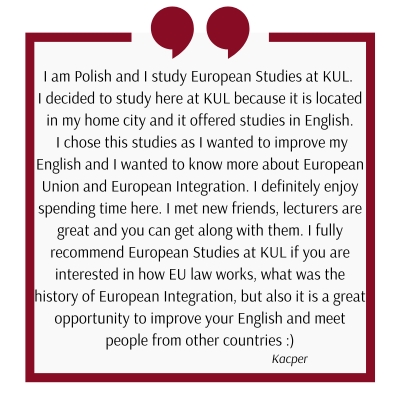
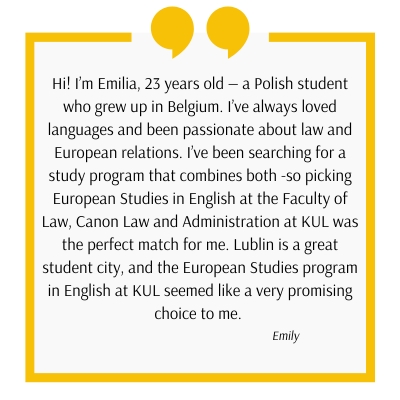
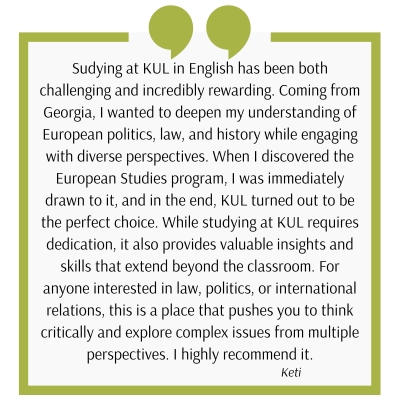
The programme’s international profile, classes taught entirely in English, and the presence of international students create an open, multicultural learning environment. This atmosphere encourages cooperation, exchange of perspectives and the development of competencies essential for careers in European and international settings.